
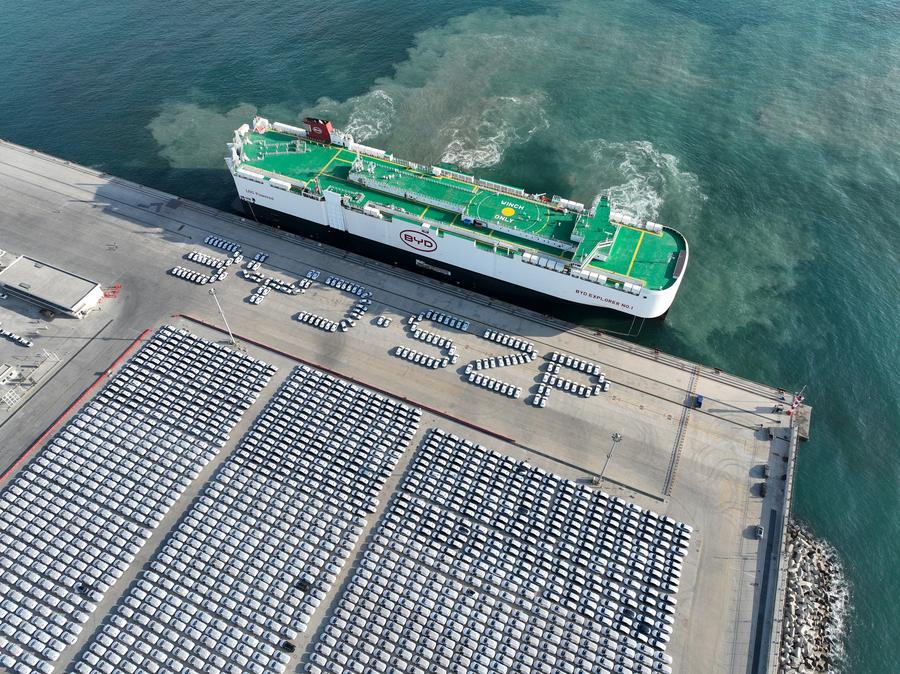
Earlier this month, BYD Shenzhen, the world's second-largest car carrier of its kind, set sail from China to Europe with 6,817 of BYD Auto's new energy vehicles onboard, marking a notable shift in the world's largest auto market once dominated by European brands.
Two weeks later, Chinese automaker BYD achieved a significant production figure by rolling out its 13 millionth NEV. The figures are very telling — in 2024 alone, the country produced and sold over 12 million NEVs, according to official data.
China's transformation from an automotive novice to an electric vehicle powerhouse has been decades in the making. In 1985, German automaker Volkswagen established China's first Sino-foreign auto joint venture with SAIC Motor in Shanghai. Its Santana model achieved 10,000-unit sales within two years.
European cars were once the benchmark for Chinese automakers, a reality BYD experienced firsthand. In early 2004, then still known as a battery maker, the Shenzhen, Guangdong province-based firm saw its first prototype vehicle bluntly dismissed by dealers as having "no hope" after a review. The setback prompted the company to adopt an aggressive learning strategy.
"We purchased and reverse-engineered dozens of market-leading cars to learn how successful models were designed," recalled BYD Chairman Wang Chuanfu. As a newcomer to the auto sector, the company adopted a two-pronged approach: learning to manufacture gasoline-powered vehicles while concurrently developing EV technology.
This focus propelled China to the forefront of the EV revolution. The country established a complete industrial chain, encompassing vehicles, batteries, electric motor control systems, autonomous driving technology, smart cockpits, charging infrastructure and the automotive after-market. This ecosystem offers a "Chinese solution" for global automotive development.
China's auto industry is seeing rebalanced partnerships between domestic and foreign automakers. A decade ago, the cooperation between China and Germany followed a pattern where Germany provided the technology, while China handled production, said Franz Raps, dean of the College of Urban Transportation and Logistics at Shenzhen Technology University.
"Today, China is developing at a rapid pace and becoming much more advanced in science and technology. I think Sino-German cooperation needs to find a new balance point," Raps said.

Scan and Share

Scan and Follow the Official Account