
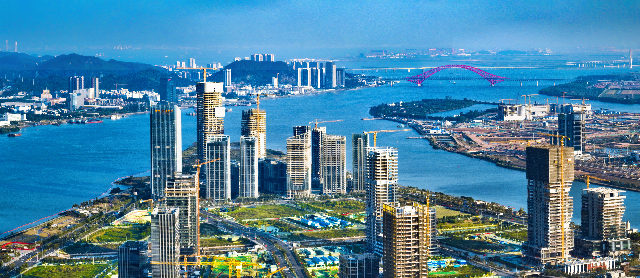
Nansha district of Guangzhou, Guangdong province. (Photo: Nanfang Daily)
Hong Kong and Macao residents working in the Nansha district of Guangzhou, capital of Guangdong province, are eligible for partial exemption from personal income tax which exceeds that in the two special administrative regions, according to a new policy.
The preferential measure, announced on Wednesday by the district government, was the first key policy implemented in Nansha following an overall plan to promote cooperation among Guangdong, Hong Kong and Macao by deepening the opening-up of the district.
In addition to building joint scientific and technological innovation systems for the three cities, the plan, released in June by the State Council, China's Cabinet, stressed the importance of creating a youth entrepreneurship and employment cooperation platform in Nansha.
"The tax policy is aimed at attracting talent from Hong Kong and Macao, and is helpful for the construction of a scientific, technological innovation and industrial cooperation base," said Wei Min, executive deputy chief of Nansha district.
He said that there are currently some 2,700 Hong Kong and Macao companies in Nansha, with investments of over $100 billion, and the Hong Kong University of Science and Technology (Guangzhou) and a school for children from the two special administrative regions will open in September.
However, there are differences between the maximum margins of personal income tax and tax rates between Hong Kong and Macao and the Chinese mainland. "The differences have become the main obstacle to high-end talent from Hong Kong and Macao working and living on the mainland," Wei said.
Apart from the existing preferential tax policy for individuals in the Guangdong-Hong Kong-Macao Greater Bay Area, the new policy, which will run until 2026, will cover all residents from the two special administrative regions working in Nansha.
"Strict benchmarking standards have been introduced and residents from Hong Kong and Macao will be exempted from tax on the part of their personal income tax that exceeds the tax collected on the same income in the two special administrative regions," said Wei.
Specific measures in terms of the definition of personal income in Nansha, the calculation method of personal income tax and the declaration of preferential tax treatment will be formulated soon, according to Wei.
According to Tao Wensheng, deputy director of Nansha's finance bureau, a special team will be created for the implementation of the preferential tax policy.
"A linkage mechanism between Guangdong, Hong Kong and Macao will be established, as it is needed to calculate the tax burden on Hong Kong and Macao residents," said Tao.
To optimize the tax environment, local authorities have also been improving the tax declaration mechanism and simplifying declaration channels, according to Tao.
"In my opinion, the preferential tax policy is based on the needs of Hong Kong and Macao residents, especially young people working and living in Nansha," said Damon Lau, a young Macao resident.
The 28-year-old began working in Nansha two years ago as a civil servant for the administrative bureau overseeing the development and construction of an industrial zone.
"It has lessened our worries, to some degree, about working and living on the Chinese mainland," he said.

Scan and Share

Scan and Follow the Official Account