
A 9-year-old boy with severe early-onset scoliosis (EOS) became the first beneficiary of the first medical equipment introduced by the University of Hong Kong-Shenzhen Hospital (HKU-SZH) under the “Hong Kong and Macao Medicine and Equipment Connect” policy, the hospital said Thursday.
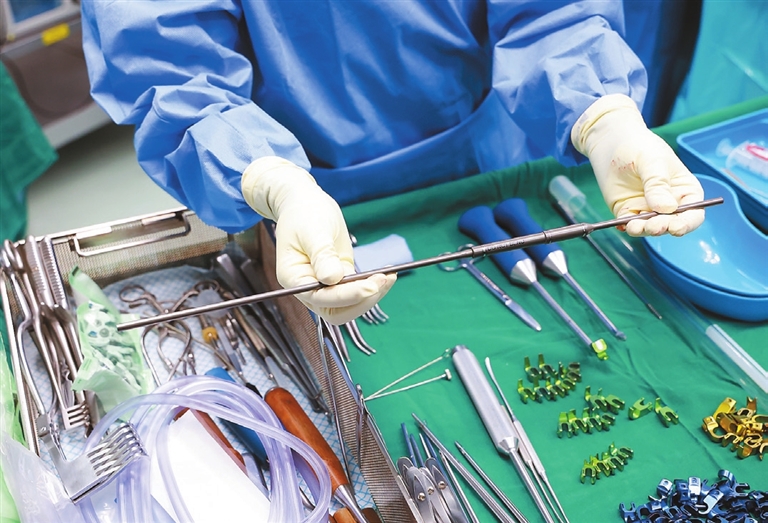
It also marked the first time that the imported medical equipment, a magnetically controlled growing titanium rod, was put into clinical use on the Chinese mainland.
The boy, identified as Xiao Lei, successfully received a titanium rod implantation performed by Professor Kenneth M.C. Cheung on Monday. Cheung is the Jessie Ho Professor in spinal surgery and the head of the department of orthopedics and traumatology at the University of Hong Kong.
Xiao Lei underwent a successful surgery under the cooperation of Professor Cheung’s team and multiple medical departments Monday. Xiao Lei, who comes from a city in northern China, was diagnosed with EOS when he was 6 years old. He is now in good condition.
At the beginning of this year, after learning that the magnetically controlled growing titanium rod would soon be put into clinical use in HKU-SZH, Xiao Lei and his parents embarked on their journey to Shenzhen for treatment. Xiao Lei was admitted to the hospital April 24.
“This was our first time to Shenzhen. We came here with a glimmer of hope that he can be cured,” Xiao Lei’s mother told the hospital.
Earlier, the family was told by doctors that a traditional metal rod implantation requires multiple operations, which would greatly affect Xiao Lei’s health as he is too young.
According to Cheung, after the surgery, Xiao Lei only needs to return for follow-up visits every 2-3 months. It is expected that the titanium rod can be stretched out 1-2 months after the implantation. In the next three years, the length of the titanium rod and the angle of Xiao Lei's spine can be adjusted regularly through the instrument until he is basically recovered.
“The magnetically controlled growing rod can not only prevent the development of deformity, but also preserve the growth potential of the patient’s spine and can reduce the risks of anesthesia and wound complications,” said Cheung. “It can be said to be a disruptive innovation.”
According to HKU-SZH, four other innovative medications have also been approved and will soon be put into pilot use at the hospital.
On April 29, Rho(D) immune globulin, a blood disease drug that was the first imported medicine under the “Hong Kong and Macao Medicine and Equipment Connect” policy, was used clinically at the hospital.

Scan and Share

Scan and Follow the Official Account